CGM for dogs and cats: see your pet's glucose on your iPhone
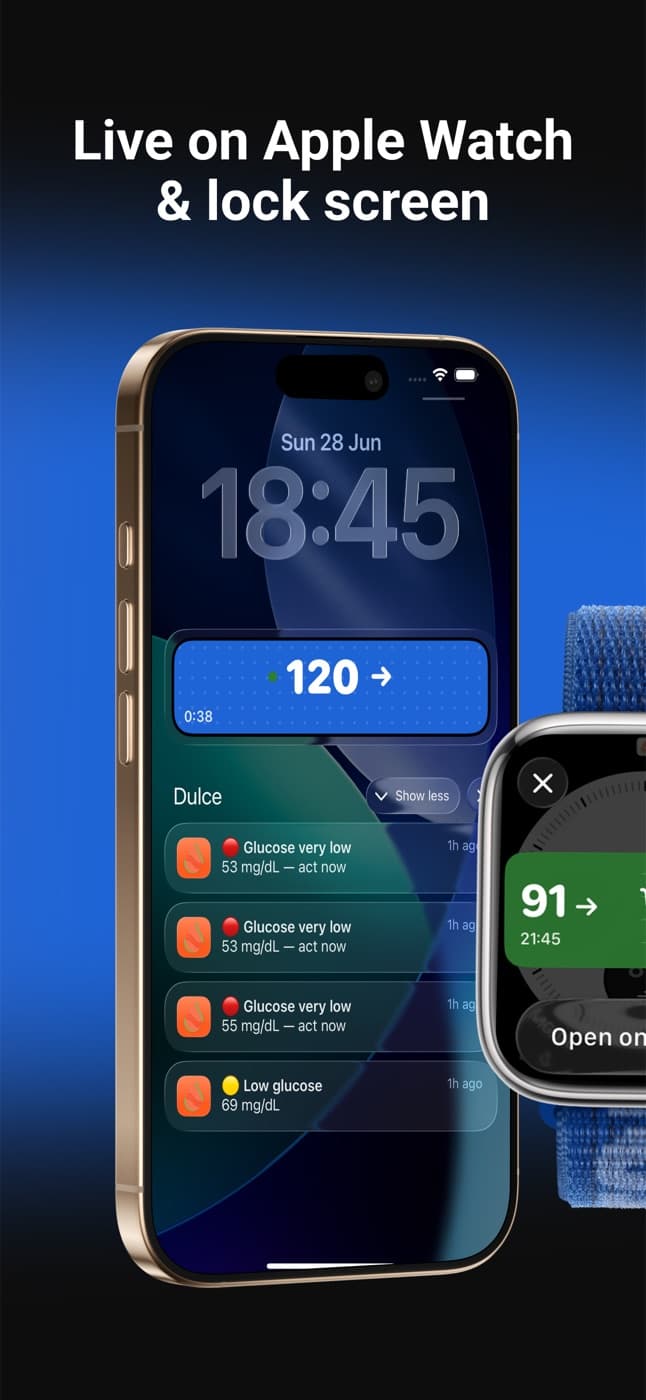
Yes, many vets use a FreeStyle Libre on dogs and cats, although it is off-label: it is clinically useful, but in marked lows (below about 55-60 mg/dL) it reads too high, so check a low reading with a meter. With Dulce's pet mode you set your vet's range, line colours and critical level, see the glucose on your Lock Screen, and as many people as you like can follow.
· 4 min read
Vets now often put a human glucose sensor on diabetic dogs and cats, most often a FreeStyle Libre. It is off-label: the sensor was made and approved for people. Studies show it is clinically useful in both species, with one important catch: it reads too high when glucose is very low. This guide covers what to know before the first sensor, and how to see your pet's glucose on your iPhone and Lock Screen with Dulce.
How a sensor on a pet works
The vet or a vet nurse places the sensor, in dogs usually on the side of the chest just behind the shoulder blade. From then on it measures glucose all the time, just like on a person, for up to 14 days if it stays on.
The readings go to a phone running the sensor's own app, over Bluetooth. That is the part people forget: the phone that reads the sensor has to stay near your pet. Many owners keep a spare phone at home next to the dog bed or the cat's favourite spot for exactly that reason.
What the studies say
- Useful overall. A 2023 veterinary review calls FreeStyle Libre the sensor used most in dogs and cats, with adequate clinical accuracy in both, and lower accuracy in the low range.
- Lows read too high. In cats, Libre 2 and Libre 3 overestimated blood glucose in marked hypoglycaemia (below about 55-60 mg/dL). The sensor may say your cat is fine when it is lower than that. Always check a low reading with a blood glucose meter before you act on it.
- Skin and sticking. In one study of 34 dogs, 71% of sensors stayed on for the full 14 days and 18% caused mild skin redness or crusting. Ask your vet how to protect the site.
Seeing your pet's glucose with Dulce
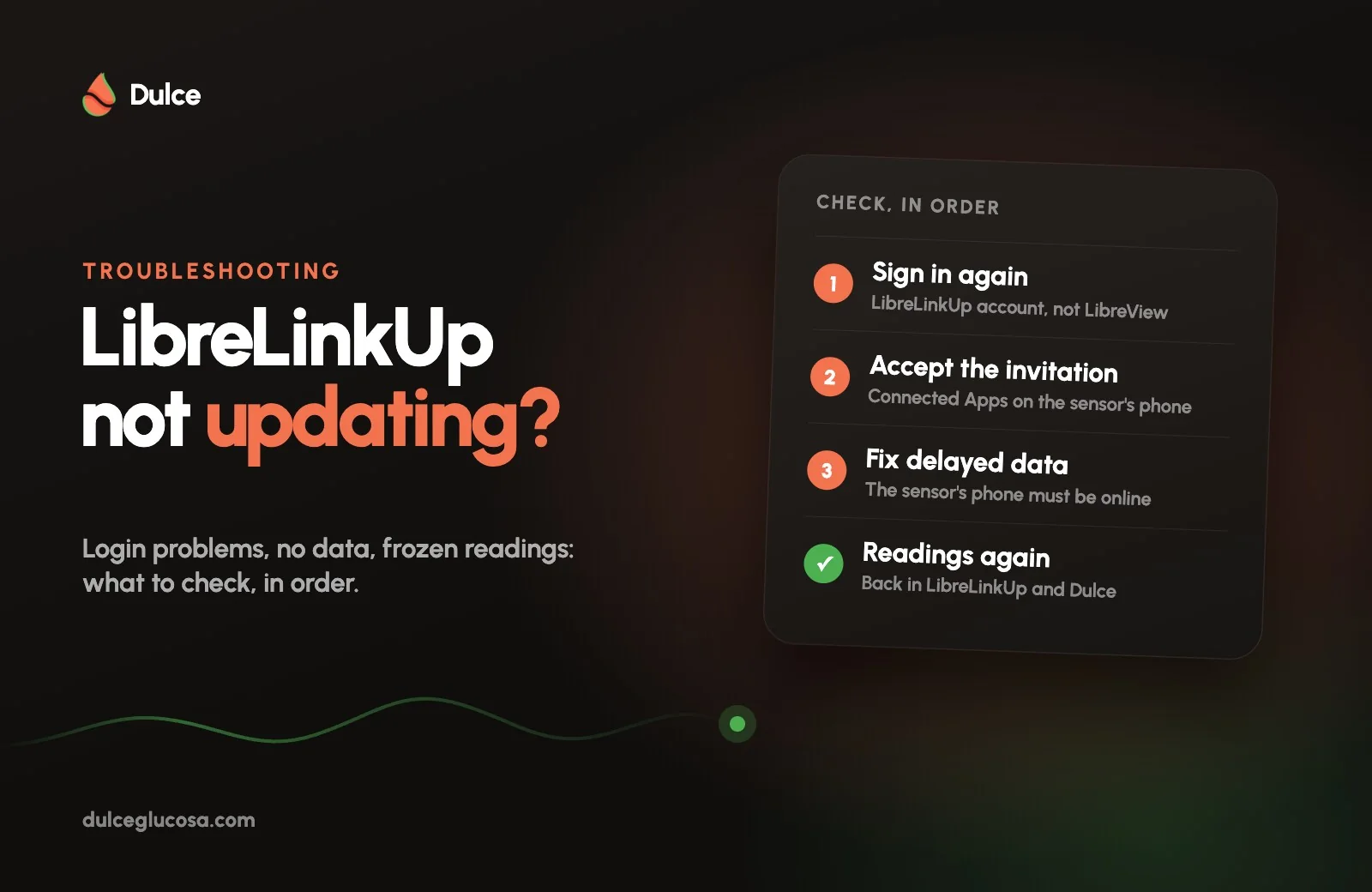
Dulce reads the sensor's sharing service, so it works the same way for a pet as for a person: with FreeStyle Libre you share from the sensor app to a LibreLinkUp account and sign in to Dulce with it. The LibreLinkUp guide helps if the share doesn't show up.
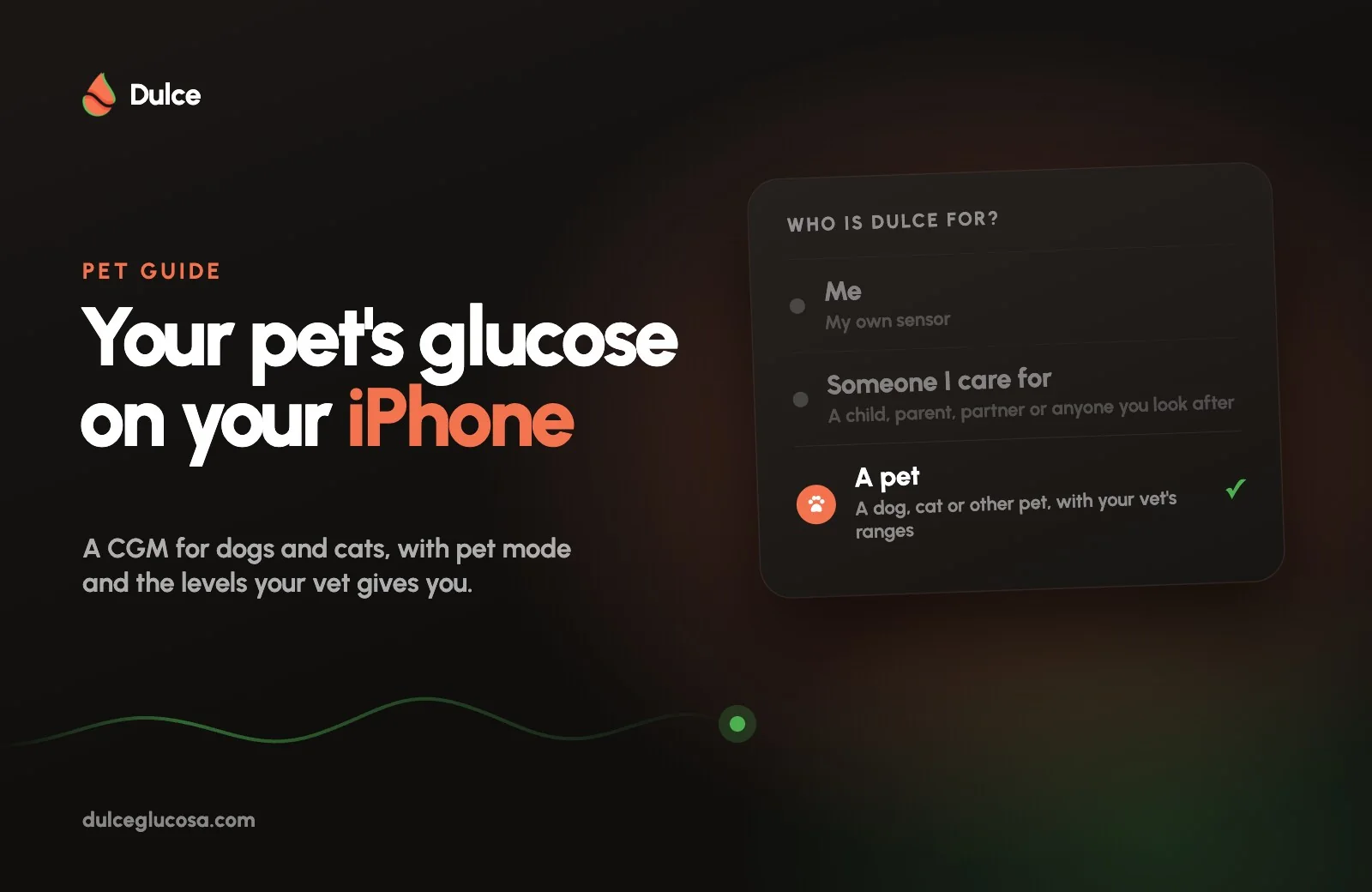
Then open Settings → Targets & units → Who is Dulce for? and choose A pet. Pet mode changes what a person's numbers would get wrong:
- Your vet's target range. The range can go much wider than for a person (low limit 40 to 200 mg/dL, high limit up to 500).
- Line colours. You choose where the chart line and the number turn red and orange, instead of the human 70 and 180.
- Critical low level. You set the level, from 40 to 90 mg/dL, at which the critical alert rings, even on silent if you allow it.
- Alerts from 40 mg/dL. Low and high alerts follow the limits your vet gives you.
The whole family, and the pet sitter
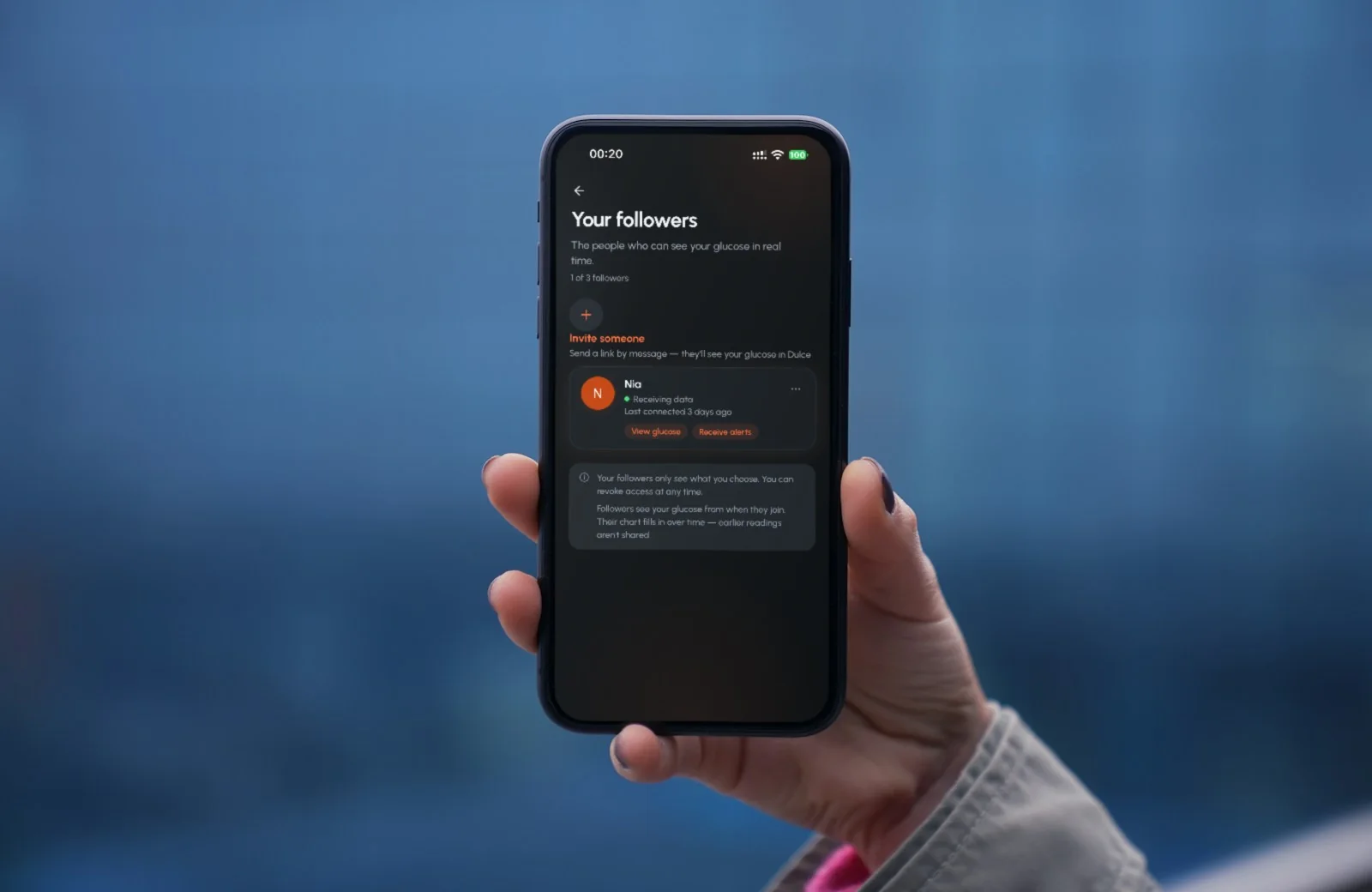
With Dulce Pro the number stays on your Lock Screen and Apple Watch while you're at work, and as many people as you like can follow from their own iPhones with their own alerts: a partner, a grown-up child, the pet sitter. Followers pay nothing. The family sharing guide shows every step, and the alerts guide explains how loud each alert can be.
What Dulce can't do
- Dulce doesn't tell you how much insulin to give or when to feed. Your vet decides that.
- If the phone near your pet is out of range or offline, the reading stops updating and Dulce shows how old it is.
- Pet mode, alerts and the logbook are free. The Live Activity, Apple Watch app and family following are Dulce Pro, with a 14-day free trial.
Sources
- Del Baldo F., Fracassi F. Continuous Glucose Monitoring in Dogs and Cats: Application of New Technology to an Old Problem. Vet Clin North Am Small Anim Pract 2023;53(3):591-613. doi.org/10.1016/j.cvsm.2023.01.008
- Berg A.S. et al. Assessment of the FreeStyle Libre 2 interstitial glucose monitor in hypo- and euglycemic cats. J Vet Intern Med 2023;37(5):1703-1709. doi.org/10.1111/jvim.16820
- Tardo A.M. et al. Accuracy of the Freestyle Libre 3 Continuous Glucose Monitoring System in Hypo- and Euglycemic Cats. J Vet Intern Med 2025;39(2):e70048. doi.org/10.1111/jvim.70048
- Campbell C., Shoelson A., Mahony O. Complications associated with a flash glucose monitoring system in diabetic dogs. Can J Vet Res 2023;87(4):260-264. PMC10542953
Quick questions
Can a FreeStyle Libre be used on a dog or cat?
Yes, many vets do it, but it is off-label because the sensor is approved for people. Your vet places it and interprets it.
Is the sensor reliable when my pet is low?
Less than in the normal range. In cats it read higher than blood below about 55-60 mg/dL, so always check a low reading with a meter.
Does Dulce have a pet mode?
Yes, from version 1.0.7. In Settings, Targets & units, Who is Dulce for?, choose A pet and enter your vet's range, line colours and critical level.
Can my pet sitter follow too?
Yes. With Dulce Pro you invite as many people as you like, who see the glucose on their own iPhone with their own alerts and pay nothing. Read more: How to share your Libre glucose with your family
This article is for information and does not replace advice from your care team. Dulce is not a medical device and does not replace your sensor's alarms.
Dulce is an independent app, not affiliated with Abbott. FreeStyle Libre, LibreLink and LibreLinkUp are trademarks of Abbott.
Founder of Dulce, lives with type 1 diabetes
Giorgi lives with type 1 diabetes and founded Dulce. He built the app because he was tired of unlocking his phone, opening an app and waiting just to see one number. He writes about what he uses every day with his sensor, iPhone and Apple Watch.