Time in range vs. A1C: what each measures and which to watch
Time in range is the share of your sensor readings between 70 and 180 mg/dL (3.9 to 10.0 mmol/L), while A1C is a blood test that reflects your average over about three months. For most adults with diabetes, the 2019 international consensus target is over 70% in range, with under 4% below 70 and under 1% below 54 mg/dL; 70% in range corresponds roughly to an A1C of 7%. Your care team may set different targets.
· 3 min read
For years the only number that mattered at the clinic was A1C. Continuous sensors brought another one: time in range. It doesn't measure the same thing and it doesn't replace A1C, but it answers the question we care about day to day: how many hours am I where I should be?
What time in range is
It's the percentage of your sensor readings between 70 and 180 mg/dL (3.9 to 10.0 mmol/L). If your time in range is 70%, you spent about 17 of the day's 24 hours inside that band.
It usually comes with two more numbers:
- Time below range: readings under 70 mg/dL, and separately those under 54 mg/dL.
- Time above range: readings over 180 mg/dL, and separately those over 250 mg/dL.
The international consensus targets
In 2019 an international group of experts published in Diabetes Care the targets most care teams use today. For most adults with type 1 or type 2 diabetes:
| Metric | Target |
|---|---|
| Time in range (70-180 mg/dL) | Over 70% (about 16 h 48 min a day) |
| Below 70 mg/dL | Under 4% (under 1 h a day) |
| Below 54 mg/dL | Under 1% (under 15 min a day) |
| Above 180 mg/dL | Under 25% (under 6 h a day) |
| Above 250 mg/dL | Under 5% (under 1 h 12 min a day) |
For older people or those at high risk of hypoglycemia, the consensus suggests more cautious targets (over 50% in range and under 1% below 70). In pregnancy with type 1 diabetes the range is tighter (63-140 mg/dL). These are general guidelines: your care team sets your targets.
The same paper notes that every 5% more time in range already brings a clinical benefit. You don't have to jump from 50% to 70% in one go.
Time in range vs. A1C
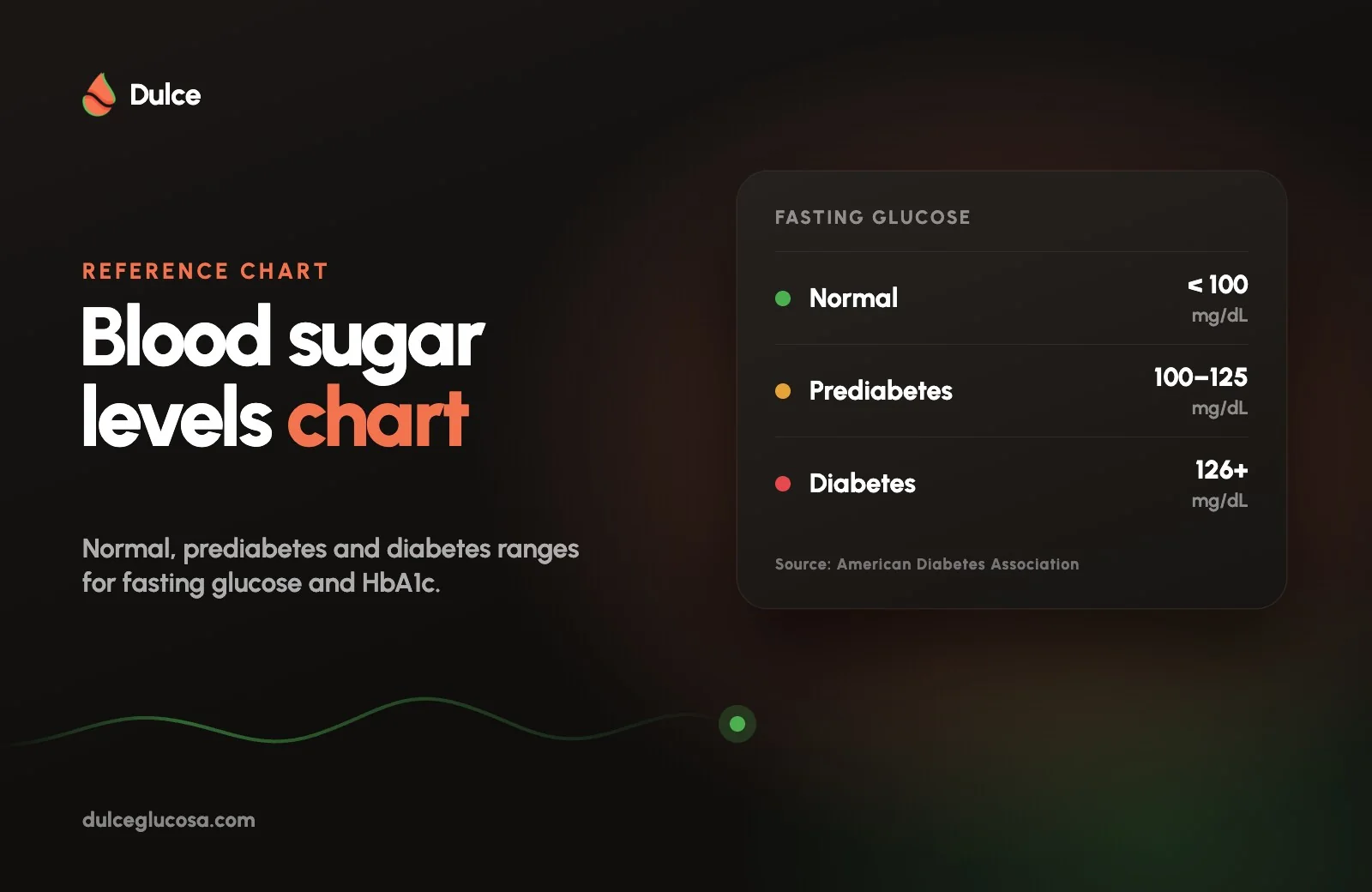
A1C is a blood test that reflects an average over about three months. Its weakness is that an average hides the extremes: two people at 7% can have calm days, or a rollercoaster of lows and highs that cancel each other out. The lab cut-offs for normal, prediabetes and diabetes are in our blood sugar levels chart.
Time in range does see those extremes, and it moves in days, not months. As a reference point, the consensus notes that 70% time in range corresponds roughly to an A1C of 7%.
Then there's GMI (glucose management indicator), which works out an A1C-like number from your sensor's average glucose. You can calculate it with our A1C and GMI calculator, where we also explain why it doesn't always match your lab result.
How to see it in Dulce
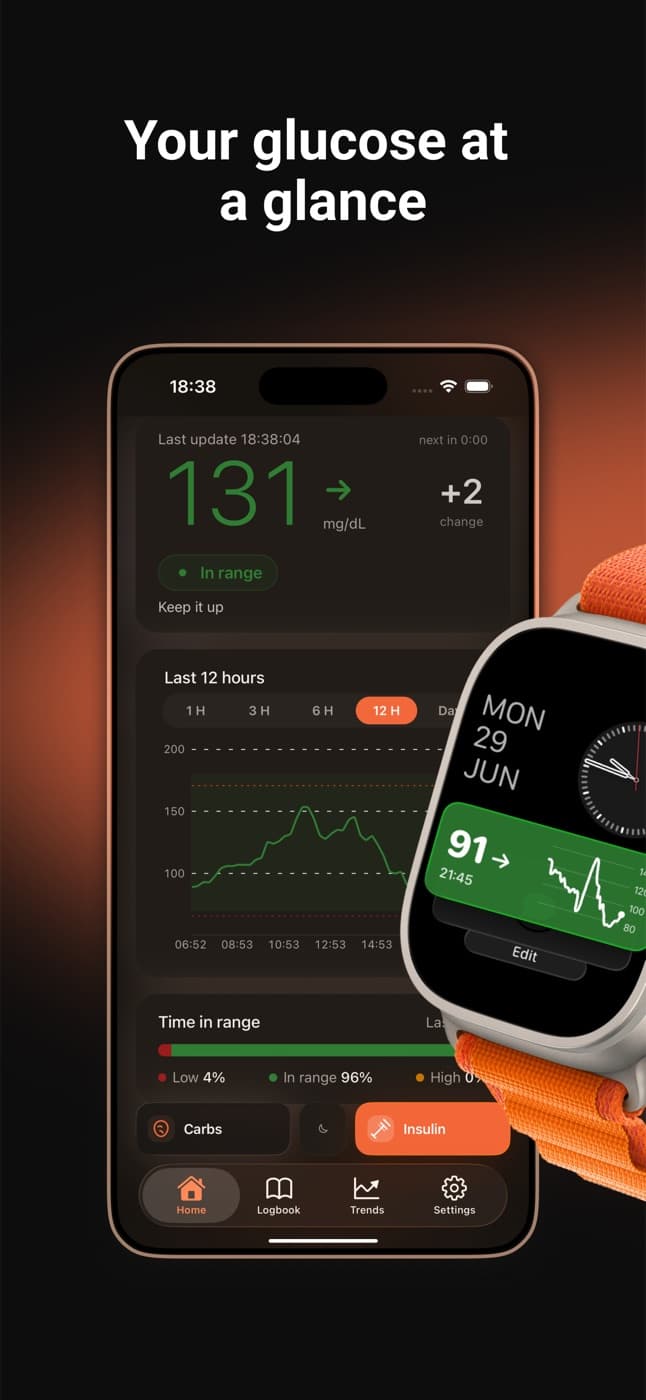
Dulce shows your time in range on the home screen and, in more detail, in the Trends tab, where you can see it over 7, 14, 30 or 90 days and split by time of day. We walk through it in the Trends guide.
In Settings you can change the target range (70-180 mg/dL by default) and your time-in-range goal (70% by default), in case your care team has given you different ones.
Just diagnosed? Start with the guide to your first weeks with type 1.
Sources
- Battelino T. et al. Clinical Targets for Continuous Glucose Monitoring Data Interpretation: Recommendations From the International Consensus on Time in Range. Diabetes Care 2019;42:1593-1603. doi.org/10.2337/dci19-0028
- Bergenstal R. M. et al. Glucose Management Indicator (GMI). Diabetes Care 2018;41:2275-2280. doi.org/10.2337/dc18-1581
Quick questions
What is a good time in range?
Over 70% between 70 and 180 mg/dL for most adults with type 1 or type 2 diabetes, according to the 2019 international consensus, with under 4% below 70 and under 1% below 54. Your care team may set different targets.
What A1C does 70% time in range correspond to?
Roughly an A1C of 7%, according to the same consensus. It's an approximation: A1C is a blood test and may not match.
How many days of data do I need?
At least 14 days, with the sensor worn 70% of the time, according to the consensus. A single day says very little. Read more: Trends in Dulce: time in range, average and GMI from your Libre
This article is for information and does not replace advice from your care team. Dulce is not a medical device and does not replace your sensor's alarms.
Dulce is an independent app, not affiliated with Abbott. FreeStyle Libre, LibreLink and LibreLinkUp are trademarks of Abbott.
Founder of Dulce, lives with type 1 diabetes
Giorgi lives with type 1 diabetes and founded Dulce. He built the app because he was tired of unlocking his phone, opening an app and waiting just to see one number. He writes about what he uses every day with his sensor, iPhone and Apple Watch.