Blood sugar levels chart: normal, prediabetes, diabetes
For non-pregnant adults, the ADA puts a normal fasting blood sugar under 100 mg/dL (5.6 mmol/L), prediabetes at 100 to 125 mg/dL and diabetes at 126 mg/dL or more, confirmed. HbA1c is normal under 5.7% (39 mmol/mol), prediabetes from 5.7% to 6.4% and diabetes from 6.5%. These lab cut-offs are for diagnosis, not targets for people already living with diabetes, whose ranges are set with their care team.
· 6 min read
Search for "normal blood sugar" and you get a dozen charts that don't agree with each other. Part of the reason is that they mix up three different things: the cut-offs used to diagnose diabetes, what glucose looks like in people without diabetes, and the targets for people who already live with it. This guide keeps them apart, with every number in mg/dL and mmol/L and where it comes from.
The chart: normal, prediabetes and diabetes
These are the American Diabetes Association's diagnostic criteria for non-pregnant adults. They apply to lab tests on blood plasma, not to sensor readings.
| Test | Normal | Prediabetes | Diabetes |
|---|---|---|---|
| Fasting glucose | Under 100 mg/dL (under 5.6 mmol/L) | 100-125 mg/dL (5.6-6.9 mmol/L) | 126 mg/dL or more (7.0 mmol/L or more) |
| 2 hours into a glucose tolerance test | Under 140 mg/dL (under 7.8 mmol/L) | 140-199 mg/dL (7.8-11.0 mmol/L) | 200 mg/dL or more (11.1 mmol/L or more) |
| HbA1c | Under 5.7% (under 39 mmol/mol) | 5.7-6.4% (39-47 mmol/mol) | 6.5% or more (48 mmol/mol or more) |
| Random glucose, with classic symptoms | 200 mg/dL or more (11.1 mmol/L or more) |
A few details that charts usually leave out:
- Fasting means no food or caloric drinks for at least 8 hours.
- The tolerance test (OGTT) is not "two hours after lunch". It's a lab test where you drink 75 g of glucose and get measured two hours later.
- One result isn't a diagnosis. Unless the picture is unmistakable, the ADA asks for two abnormal results, either from the same sample or from two separate tests.
- Not everyone draws the prediabetes line at 100. The World Health Organization uses the same diabetes cut-offs, but its "impaired fasting glucose" starts at 110 mg/dL (6.1 mmol/L). So a fasting 105 mg/dL can be called normal on one lab report and prediabetes on another.
What "normal" looks like hour by hour
Diagnostic cut-offs say little about how glucose moves during a day. For that, a 2019 study put a continuous glucose sensor on 153 healthy people without diabetes, aged 7 to 80, for up to 10 days. What it found:
- Average glucose was around 98-99 mg/dL (5.4-5.5 mmol/L), and about 104 mg/dL in people over 60.
- They spent a median 96% of the time between 70 and 140 mg/dL (3.9-7.8 mmol/L).
- They spent about 30 minutes a day above 140 and about 15 minutes below 70.
So a short rise after a meal is normal, even without diabetes. Staying above 140 mg/dL for hours is not what this group's days looked like.
Targets if you have diabetes
For many non-pregnant adults with diabetes, the ADA suggests:
| What | Target |
|---|---|
| HbA1c | Under 7% (under 53 mmol/mol) |
| Before meals | 80-130 mg/dL (4.4-7.2 mmol/L) |
| Peak after meals (1-2 h after you start eating) | Under 180 mg/dL (under 10.0 mmol/L) |
| Time in range with a sensor (70-180 mg/dL) | Over 70% of the day |
The ADA is explicit that these goals are a starting point. They can be stricter if they're reachable without lows, and looser for people for whom lows are a bigger risk, such as many older adults with other health conditions. Children and pregnancy have their own targets. Your care team sets yours.
With a sensor, time in range has become as important as HbA1c because it shows the lows and highs an average hides. We explain the full set of sensor targets in time in range vs. A1C.
Low and high: where the lines are
The ADA classifies lows in three levels, the same day and night:
| Level | Glucose |
|---|---|
| Level 1 | Under 70 mg/dL (3.9 mmol/L) and 54 mg/dL or more |
| Level 2 | Under 54 mg/dL (3.0 mmol/L) |
| Level 3 | A severe event where you need someone else's help, at any number |
On the high side, the time-in-range consensus counts readings over 180 mg/dL (10.0 mmol/L) as above range and over 250 mg/dL (13.9 mmol/L) as very high, with a general goal of under 5% of the time up there.
If a reading looks wrong for how you feel, confirm it with your sensor or a fingerstick meter, and act on the plan you've agreed with your care team, not on a chart. Lows during sleep are their own topic: see nocturnal hypoglycemia.
HbA1c in % and mmol/mol
Labs report HbA1c either as a percentage (NGSP) or in mmol/mol (IFCC), and some print both. The two are linked by a fixed equation:
| % | mmol/mol |
|---|---|
| 5.7 | 39 |
| 6.0 | 42 |
| 6.5 | 48 |
| 7.0 | 53 |
| 7.5 | 58 |
| 8.0 | 64 |
To turn an HbA1c into an estimated average glucose, or a sensor average into an estimated A1C (GMI), use our A1C and GMI calculator.
mg/dL or mmol/L
Same glucose, two units. To go from mg/dL to mmol/L, divide by 18 (precisely 18.016); to go back, multiply. 100 mg/dL is 5.6 mmol/L, 180 mg/dL is 10.0 mmol/L. Spain, Italy, France and the US mostly use mg/dL; the UK, Ireland, Canada and Australia use mmol/L; in Germany you'll see both. For any other number there's the mg/dL to mmol/L converter.
Your own range in Dulce
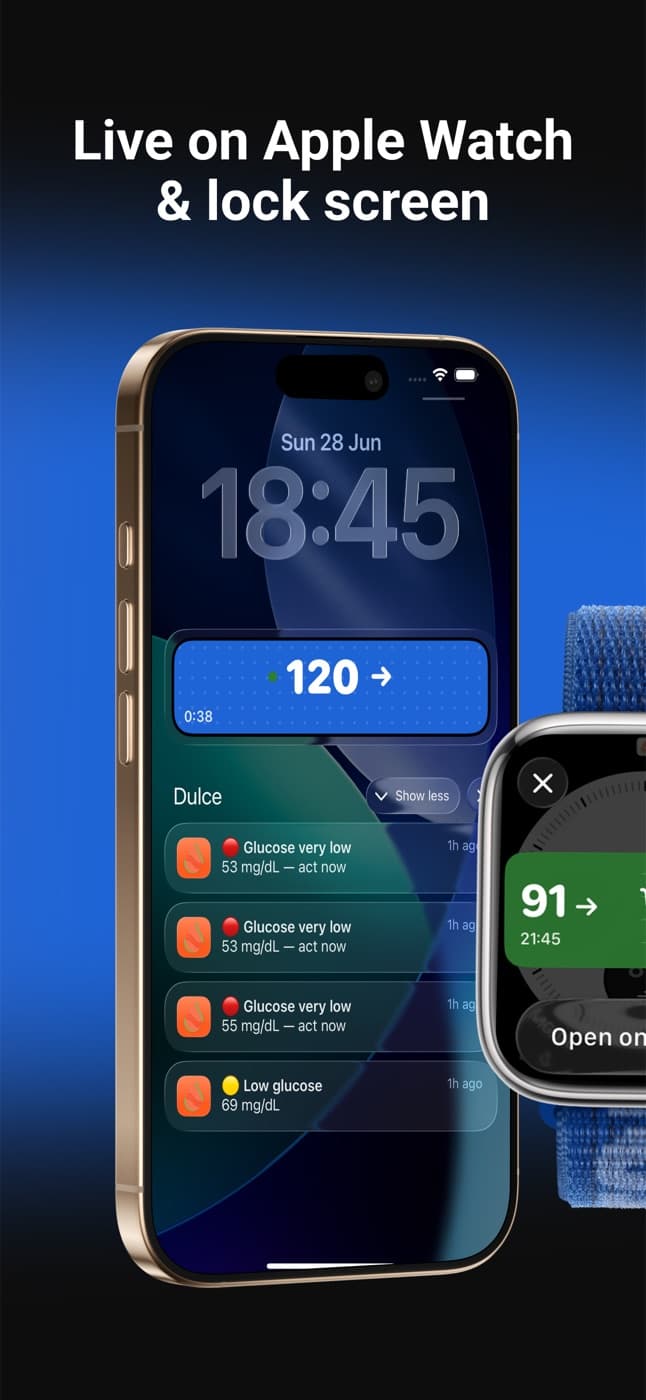
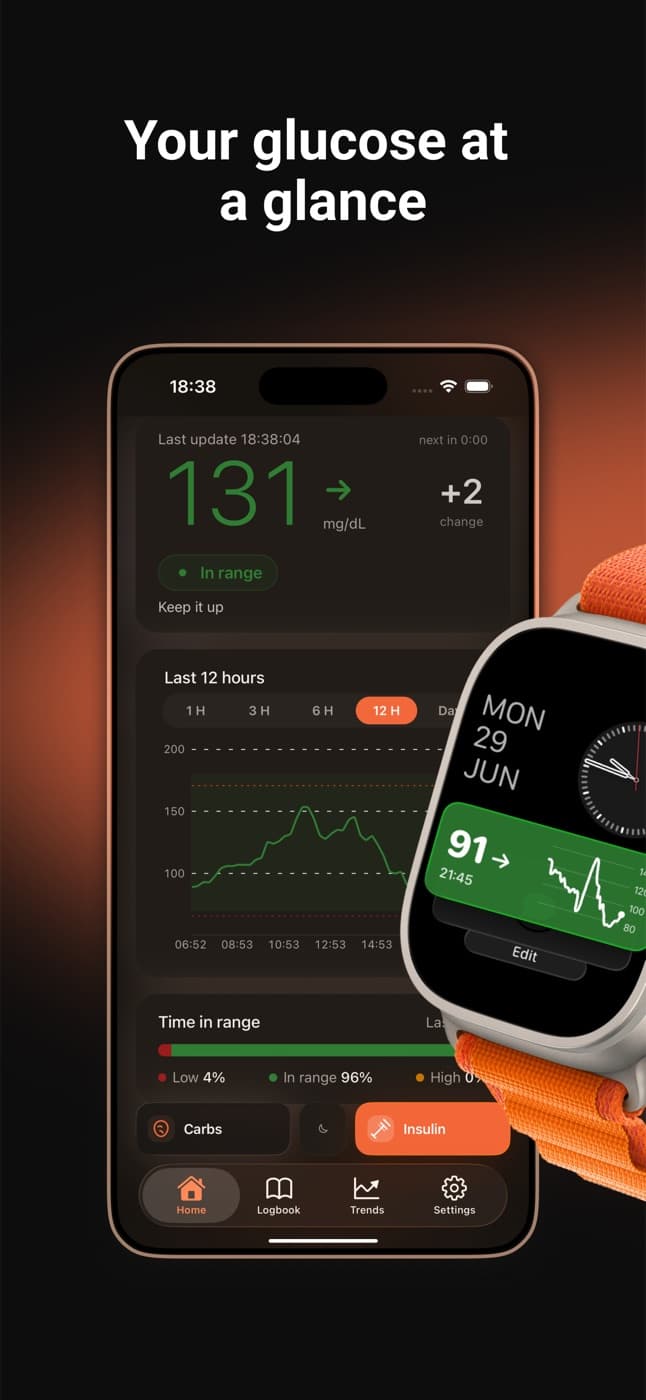
Dulce shows FreeStyle Libre and Dexcom readings on your Lock Screen, Apple Watch and widgets, so it helps if those numbers are in the unit and range you actually use.
Pick your unit
In Settings → Units choose mg/dL or mmol/L. It changes every number in the app, on the Lock Screen and in the widgets.
Set your target range
Settings → Target range is 70-180 mg/dL by default. You can move the low end between 50 and 150 and the high end between 120 and 300, in steps of 5 mg/dL. It sets the in-range coloring on Home and in Trends.
Set your time-in-range goal
On the same screen, Time-in-range goal is 70% by default and goes from 50% to 95%. Use the numbers your care team gave you.
The Trends tab then shows your time in range and an Est. A1C from GMI over 7, 14, 30 or 90 days, as explained in the Trends guide. GMI is an estimate and doesn't replace a lab HbA1c.
Sources
- American Diabetes Association Professional Practice Committee. Diagnosis and Classification of Diabetes: Standards of Care in Diabetes-2026. Diabetes Care 2026;49(Suppl 1):S27-S49. doi.org/10.2337/dc26-S002
- American Diabetes Association Professional Practice Committee. Glycemic Goals, Hypoglycemia, and Hyperglycemic Crises: Standards of Care in Diabetes-2026. Diabetes Care 2026;49(Suppl 1):S132-S149. doi.org/10.2337/dc26-S006
- World Health Organization, International Diabetes Federation. Definition and diagnosis of diabetes mellitus and intermediate hyperglycaemia. Geneva: WHO; 2006. who.int
- Shah V. N. et al. Continuous Glucose Monitoring Profiles in Healthy Nondiabetic Participants: A Multicenter Prospective Study. J Clin Endocrinol Metab 2019;104(10):4356-4364. doi.org/10.1210/jc.2018-02763
- Battelino T. et al. Clinical Targets for Continuous Glucose Monitoring Data Interpretation: Recommendations From the International Consensus on Time in Range. Diabetes Care 2019;42:1593-1603. doi.org/10.2337/dci19-0028
- Hoelzel W. et al. IFCC reference system for measurement of hemoglobin A1c in human blood and the national standardization schemes in the United States, Japan, and Sweden: a method-comparison study. Clin Chem 2004;50(1):166-174. doi.org/10.1373/clinchem.2003.024802
Quick questions
What is a normal fasting blood sugar?
Under 100 mg/dL (5.6 mmol/L), according to the ADA. 100 to 125 mg/dL counts as prediabetes and 126 mg/dL or more, confirmed, as diabetes. The WHO starts impaired fasting glucose at 110 mg/dL.
What HbA1c is normal?
Under 5.7% (39 mmol/mol). 5.7% to 6.4% is prediabetes and 6.5% or more, confirmed, is diabetes. For people with diabetes, the ADA's usual goal is under 7%.
Can a sensor or a meter diagnose diabetes?
No. Diabetes is diagnosed from laboratory tests ordered by a doctor, usually repeated. A sensor or a meter is for everyday management, not for diagnosis.
This article is for information and does not replace advice from your care team. Dulce is not a medical device and does not replace your sensor's alarms.
Dulce is an independent app, not affiliated with Abbott. FreeStyle Libre, LibreLink and LibreLinkUp are trademarks of Abbott.
Founder of Dulce, lives with type 1 diabetes
Giorgi lives with type 1 diabetes and founded Dulce. He built the app because he was tired of unlocking his phone, opening an app and waiting just to see one number. He writes about what he uses every day with his sensor, iPhone and Apple Watch.